Mostrando entradas con la etiqueta Inglés. Mostrar todas las entradas

sábado, 26 de septiembre de 2020

 REMEMBER ❕❕

"The rules of the classroom"

Esta semana hemos recordado las normas de clase en inglés con divertidos videos y canciones, aquí puedes volver a escucharlas.

👇

👇


viernes, 25 de septiembre de 2020


CORONA-VIRUS SHOO!

Ya que os ha gustado tanto, aquí podéis volver a escuchar el video utilizado en clase esta semana y que resume aquellas acciones que nos ayudan a protegernos.

Actions to protect ourselves

👇


lunes, 22 de junio de 2020

INGLÉS 2 (Semana 22 - 25 junio)

Hi everyone,

Book: All about me. Progress Booklet (yellow book)
Libro: All about me. Progress Booklet (libro amarillo)

  • Unit 5. “I’m at the canteen”. Page 12. Exercises 1 and 2.
  • Unidad 5. "Estoy en la cantina" Página 12. Ejercicios 1 y 2.


  • Unit 5. “I’m at the canteen”. Page 13. Exercises 5 and 6.

  • Unidad 5. "Estoy en la cantina" Página 13. Ejercicios 5 y 6.


Have a wonderful summer! 

The English Teachers 

lunes, 15 de junio de 2020

INGLÉS (Semana 15 - 19 junio)

Hi everyone,


Tarea 1.

1. Reading. Lectura.

  • Read the test "Rest and sleep” on pages 22 and 23 from the small purple book "How to stay healthy". 
  • (Lee el texto "Descansar y dormir" en las páginas 22 y 23 del libro pequeño lila "Cómo estar saludable")


2. Activities. Actividades.

  • Do activities 1, 2, 3 and 4 on pages 42 and 43 from the small purple book "How to stay healthy".
  • (Contestar a las preguntas 1, 2 , 3 y 4 de las páginas 42 y 43 del libro pequeño lila "Cómo estar saludable".)


 Tarea 2.


“The olympics” (Los juegos olimpicos)

  • Watch the video. (Visualizar el video)
  • Do the worksheet and answer the questions. (Hacer ficha y contestar a las preguntas)
  • Ficha


Tarea 3. "Interview about sports" (Entrevista sobre deportes)


  • Check the document with questions. (Ver documento con preguntas) (en diario semanal)


    • Interview someone and record it, send it to the teacher. (Entrevistar a alguien y grabar para enviar a la teacher)


    Have a good week,

    English Teachers

    lunes, 1 de junio de 2020

    INGLÉS (Semana 1-5 de junio)

    Hi Everyone,

    Sesión 1

    Class Book. Pág. 48. Review the vocabulary 1-8
    1. Write the words in your notebook and make a draw for each. Escribe las palabras en tu libreta y haz un dibujo de cada una.
    2. Watch the video and listen to the song. Visualiza el video y escucha la canción. (ENLACE EN DIARIO)

    1. Listen to the song and complete words missing in the text, you can write a list in your notebook 1, 2, 3, 4....15. Escucha la canción y completa las palabras que faltan en el texto. Puedes escribir en tu libreta las palabras en una lista 1, 2, 3, 4, ... hasta el 15.
    2. Class Book. Pág. 49. Check your answers. Comprueba tus respuestas.


    Sesión 2


    Class Book. Pág. 51
    1. Listen to the song again. Escucha la canción otra vez.
    2. Do you know more words related to food? Write them down in your notebook. Sabes más palabras relacionadas con la comida. Escríbelas.
    Activity Book. Pág. 40
    1. Do exercises 1 and 2. Hacer ejercicio 1 y 2.

    Sesión 3


    Video. Story. The very hungry caterpillar. Visualizar video.
    (ENLACE EN DIARIO)

    1. Watch the story. Visualiza la historia.
    2. Complete the table with the food. Write the days of the week and the food in your notebook.

    a) What did he eat? (¿Qué comió?)
    Monday =
    Tuesday =
    Wednesday =
    Thursday =
    Friday =
    Saturday =
    Sunday =

    lunes, 25 de mayo de 2020

    INGLÉS (Semana 25 - 29 mayo)


    Sessión 1

    1. Watch the video about physical description. Visualizar el video sobre descripción física.


    2. Do exercise 6 describing 2 pictures. You can print the worksheet or do it in your notebook. Hacer el ejercicio 6 describiendo los 2 dibujos. Puedes imprimir la ficha of hacerlo en tu libreta.


    3. Do exercise 7 putting words in order to make a sentence. Hacer el ejercicio 7 ordenando las palabras para hacer una frase. 


    Sessión 2

    1. Watch the video about wild animals.


    2. Do exercise 5. Hacer ejercicio 5 de la ficha.


    3. Do exercise 6 using there is. Hacer ejercicio 6 usando there is.
    Examples from the video. Ejemplos del video a continuación:
    - There is a cake = Hay un pastel (singular, una sola cosa)
    - There are 10 baloons = Hay 10 globos. (plural, 2 o más cosas)

    4. Write 5 sentences in your notebook using there are (plural). Escribe 5 frases en tu libreta usando There are (plural). Recuerda que son 2 o más cosas.


    Sessión 3


    1. Watch the videos 1 and 2 again (session 1), choose your favourite hero and describe them in your notebook. Make a draw.
    Visualiza los videos 1 y 2 otra vez (sesión 1), escoge tu héroe o heroina favorito/a y haz una descripción física en tu libreta. Haz un dibujo también.

    2. Watch the video 3 again and write the name of all the animals in your notebook. Do you know more names of animals?
    Visualiza el video 3 (sesión 2) otra vez y escribe en tu libreta los nombres de todos los animales. ¿Sabes más nombres de animales?

    3. Write 4 sentences in your notebook using there is (singular) and 4 sentences using there are (plural). Choose things that are around the house.
    Escribe en tu libreta 4 frases usando there is (hay, singular) y 4 frases usando there are (hay, plural). Elige cosas que haya en tu casa.


    Enjoy!

    English Teachers

    lunes, 18 de mayo de 2020

    ENGLISH

    Hello everyone,

    Session 1

    Soluciones de la semana pasada:


    1. Listen to the audio about the circle of friends (Escucha el audio sobre el círculo de amigos)
    Circle of friends

    2. Read the text about the circle of friends, it is like a poem. Then, listen to the audio again and read the text.
    (Lee el texto sobre el círculo de amigos, es como un poema. Luego escucha el audio y lee el texto al mismo tiempo.)


    3. After you can read the text again and play.
    (Después de volver a leer el texto. Juega.)

    GAMES (juegos)

    The games are in the following order (Los juegos aparecen en el siguiente orden):

    Game. Primer juego. Click on the word and click on the space. (Pincha en la palabra y luego pincha en el hueco vacío.)

    Game. Segundo juego. Choose one option (Elige 1 opción.)

    Game. Tercer juego. Order the words to make a sentence (Ordena la frase.)


    Session 2
    Worksheet (page 1)

    Video 1:

    Video 2: Places in town

    1. Ficha 1. Ejercicio 1, 2 y 3


    Afirmativa
    There is = hay (singular). Ejemplo: There is a worksheet for homework
    There are = hay (plural) There are ten numbers in exercise 1.
    Negativa
    There isn't = no hay (singular)
    There aren't = no hay (plural)
    Pregunta
    Is there? = ¿Hay? Ejemplo: Is there one exercise in worksheet 1? No, there aren't. There are 3.
    Are there? = ¿Hay? Ejemplo: Are there 5 pictures in exercise 1? Yes, there are.


    2. In your notebook. Write the questions and answers to the following questions about what things there are/is in your house.
    (En tu libreta. Escribe la pregunta y contesta a las siguientes preguntas sobre cosas que hay en tu casa.)
    Are there rolescates in your house?
    Is there a washing machine in your bedroom?
    Are there toys in your house?
    Is there a computer in your house?
    Are there trees around your house?
    Is there an animaltron in your house?


    Session 3
    Worksheet (page 2)

    1. Visualiza el video
    Video:
    He likes / she likes

    2. Exercise 4 y 5


    3. Choose one of your partners at school and write 6 sentences in your  notebook about things they like and things they don't like. Use "He likes...." or "She likes"for 3 sentences in affirmative. Write "He doesn't like", "She doesn't like" for 3 sentences in negative.
    (Elige un compañero o compañera del cole y escribe 6 frases en tu libreta sobre que cosas le gustan y que cosas no les gustan usando "He likes...." o "She likes". También puedes escribir cosas que no le gustan "He doesn't like", "She doesn't like". Escribe 3 frases en afirmativa y 3 frases en negativa.)


    Have a great week,

    English Teachers

    lunes, 11 de mayo de 2020

    ENGLISH (Semana 11-15 Mayo)

    Good morning everyone,

    We hope you are good, we are happy you now have more freedom to go out and enjoy some fresh air. Take care of yourself.
    Esperamos que estéis bien, estamos contentas de que podáis tener más libertad para salir y disfrutar al aire libre. Cuidaros mucho.

    Session 1

    “Meses del año”, “3ª persona he/she”.
    Video: Months of the year. (meses del año)

    Video: Months of the year

    1. Ficha 1. Ejercicios 1. 

    2. Ficha 1. Ejercicios 2.


    3. Answer some questions. What can you do you are proud of? Explore something you would like to get better at and do it. What do you choose to get better at?


    Session 2

    Chant: I am wearing

    Sesión 2: “Cloth and Food”

    1. Song: “I am wearing…” (canción)
    2. Make a list of the different clothes that are shown in the video. (Haz una lista de la ropa diferente que sale en el video)
    3. Play the game: Food 1. (Juega al juego)
    4. Play the game: Food 2. (Juega al juego)
    Nota: para los juegos entras en el enlace y baja con el cursor hasta encontrar "Food 1" y "Food 2"

    Juegos: Food 1, Food 2


    Session 3

    “He/she is wearing”, “I like (food)”
    Ficha 2. 
    1. Ejercicios 3 
    2. Ejercicio 4

    Ficha 2:


    3. Answer to some questions on your notebook (contesta a algunas preguntas)
    What are you wearing today? (¿Qué llevas puesto hoy?
    What is your favourite outfit? (¿Cual es tu ropa favorita?)
    Do you like dressing up? (¿Te gusta disfrazarte?)
    What's your favourite costume? (¿Cual es tu disfraz favorito?)


    Nota: Aquí tienes la solución de la ficha de la semana pasada.


    See you later alligator (in a while crocodile)

    English Teachers

    lunes, 4 de mayo de 2020

    ENGLISH (Semana 4-8 mayo)

    English

    Hello children,

    We hope you are fine. Here you have the tasks for this week.
    Esperamos que estéis bien. Aquí tenéis las tareas de la semana.

    ENGLISH (Semana 4-8 mayo)


    Session 1

    Video: Healthy food

    Exercise 1:
    Write in your notebook 2 columns, one with the of unhealthy food that shows the video and another one with the healthy food.
    Escribe en tu libreta 2 comunas, una con la lista de la comida no saludable que aparece en el video y otra con la comida saludable.

    Exercise 2:
    Make a little draw of each food.

    Exercise 3:
    Check last week answers. Comprobar las respuestas de la semana pasada.


    Session 2

    Worksheet 1

    1 Do exercise 1 and 2. Realizar los ejercicios 1 y 2.
    Nota: Si no puedes imprimir la ficha hazla en tu libreta.


    Session 3

    1 Do exercise 3 and 4. Realizar los ejercicios 3 y 4.
    Nota: Si no puedes imprimir la ficha hazla en tu libreta.


    Take care of yourself,
    Cuidaros mucho,

    English Teachers 

    lunes, 27 de abril de 2020

    ENGLISH (Semana 27 - 30 abril)

    Hello children,

    We hope you are fine. Here you have the tasks for this week.
    Esperamos que estéis bien. Aquí tenéis las tareas de la semana.

    ENGLISH (Semana 27 - 30 abril)


    Session 1

    Class book. Unit 1. Page 4.

    1.     Review the vocabulary about health problems. Revisa el vocabulario de los problemas de salud.
    2.     Copy the song in your notebook and underline the health problem words. Copia la canción en tu libreta y subraya las palabras del vocabulario.

    3.  Review the exercise from last week. You have the answers at the bottom of this document. Revisa los ejercicios de la semana pasada. Tienes las soluciones al final de este documento. 


    SONG - HEALTH PROBLEMS
    1. Hello Doctor Foster
    What’s the matter with you?
    I’ve got a headache,
    And a cut, too.
    Chorus
    Toothache, earache,
    a stomach-ache, too!

    We’re at the doctor’s.
    Get well soon!
    2. Hello Doctor Foster
    What's the matter with you?
    I’ve got a temperature ,
    And a cough, too.

    We’re at the doctor’s.
    Get well soon!
    3. Hello Doctor Foster
    What's the matter with you?
    I’ve got a headache,
    And a cold, too.

    We’re at the doctor’s.
    Get well soon!


    Session 2
    -Watch the video about the health problems and, listen and repeat the vocabulary. Look at the words below and copy them on your notebook. As you can see we are going to learn some new words.
    -Visualiza el video sobre los problemas de salud, escucha y repite el vocabulario. Mira las palaras que están abajo y copialas en tu libreta. Como puedes ver vamos a aprender algunas palabras nuevas.

    Vocabulary – vocabulario
    Cold = resfriado
    Cough = tos
    Cut = corte
    Fever = Temperature = fiebre
    Get one arm broken = romperse el brazo
    headache = dolor de cabeza
    Runny nose = mocos
    Sore throat = dolor de garganta
    Stomachache = dolor de estómago
    Toothache = dolor de muelas


    Session 3

    1.     Watch the story about the boy who is not well (he is ill).
    Visualiza la historia sobre el niño que no se encuentra bien (está enfermo)

    2.     Watch and read the story.
    Visualiza y lee la historia.


    3.     Do exercise 1. Make the draws in your notebook and write the words under the picture.
    Hacer ejercicio 1. Hacer los dibujos en la libreta y escribir las palabras debajo de cada dibujo.


    You can take pictures of your work and send them to the teacher. Puedes hacer fotos de tu trabajo y enviarlos a la profe.

    Aquí tienes la solución de las fichas de la semana pasada. (semana 4 20-24 abril)


    Take care and see you soon,
    Cuidaros y nos vemos pronto, 

    English Teachers 


    lunes, 20 de abril de 2020

    ENGLISH (Semana 20 - 24 abril)


    Hello children,
    Here you have the tasks for this week.
    Aquí tenéis las tareas de la semana.


    ENGLISH (Semana 20 - 24 abril) SESIÓN 1.

    Worksheet 1. Do exercise 1 and 2. If you can not print the sheet copy the exercise in your notebook.
    Ficha 1. Realizar ejercicios 1 y 2. Si no puedes imprimirla copiar los ejercicios en la libreta.


    ENGLISH (Semana 20 - 24 abril) SESIÓN 2.

    Worksheet 2. Do exercise 3 and 4. If you can not print the sheet copy the exercise in your notebook.
    Ficha 2. Realizar ejercicios 3 y 4. Si no puedes imprimirla copiar los ejercicios en la libreta


    ENGLISH (Semana 20 - 24 abril) SESIÓN 3.

    1. Write the date in your notebook using the days of the week and the ordinal numbers. (Look at the video for review).
    - Escribe en tu libreta la fecha usando los días de la semana y los números ordinales. (Visualizar videos para repaso).

    2. Watch the video about the ordinal numbers.
    - Visualizar el video de los números ordinales.

    Video Ordinal numbers (Números ordinales)

    3. Write in your notebook the ordinal numbers shown in the video from 1st-10th
    Escribe en tu libreta los números ordinales que aparecen en el video del 1º-10º.

    Video: Días de la semana


    We hope you are very well. Take care and stay home.
    Esperamos que estéis muy bien. Cuidate y quédate en casa.

    English teachers

    lunes, 30 de marzo de 2020

    ENGLISH (Semana 30 - 3 marzo abril)

    SESIÓN 1.

    PROJECT UNIT 4

    -   CLASS BOOK. (page 44 y 45)
    Look at Lilis project and make your own project.
    Mira el proyecto de Lili y haz tu propio proyecto.
    -   ACTIVITY BOOK (page 37)
    Now copy the information in exercise 2 in a piece of paper and design the final version of your project. Ahora copia la información del ejercicio 2 en un folio y diseña la versión final de tu proyecto.


    SESIÓN 2

    -   LIBRO PEQUEÑO AMARILLO “PROGRESS BOOKLET”. (page 11).

    Exercise 7. Ejercicio 7.
    Draw a picture of you and your family. Write a description. You can use the vocabulary on the CLASS BOOK story in unit 1 (page 8). Dark hair, fair hair, red hair, tall, thin, good-looking. You can also look at the vocabulary in your notebook.


    • Example (ejemplo): 

    - Hair: He has got dark hair. Pelo: El tiene el pelo oscuro.
    - Altura, complexion, aspecto: She is tall. Ella es alta. 

    Dibujate a ti y a tu familia. Escribe una descripción. Puedes usar el vocabulario de la historia de la unidad 1(página 8). Pelo oscuro, pelo rubio, pelirrojo/a, alto/a, delgado/a, guapo/a.  También puedes mirar tu libreta con el vocabulario de la unidad 1 y la página 10 del class book.


    Ampliación del ejercicio 7 (Writing/ ejercicio escrito):
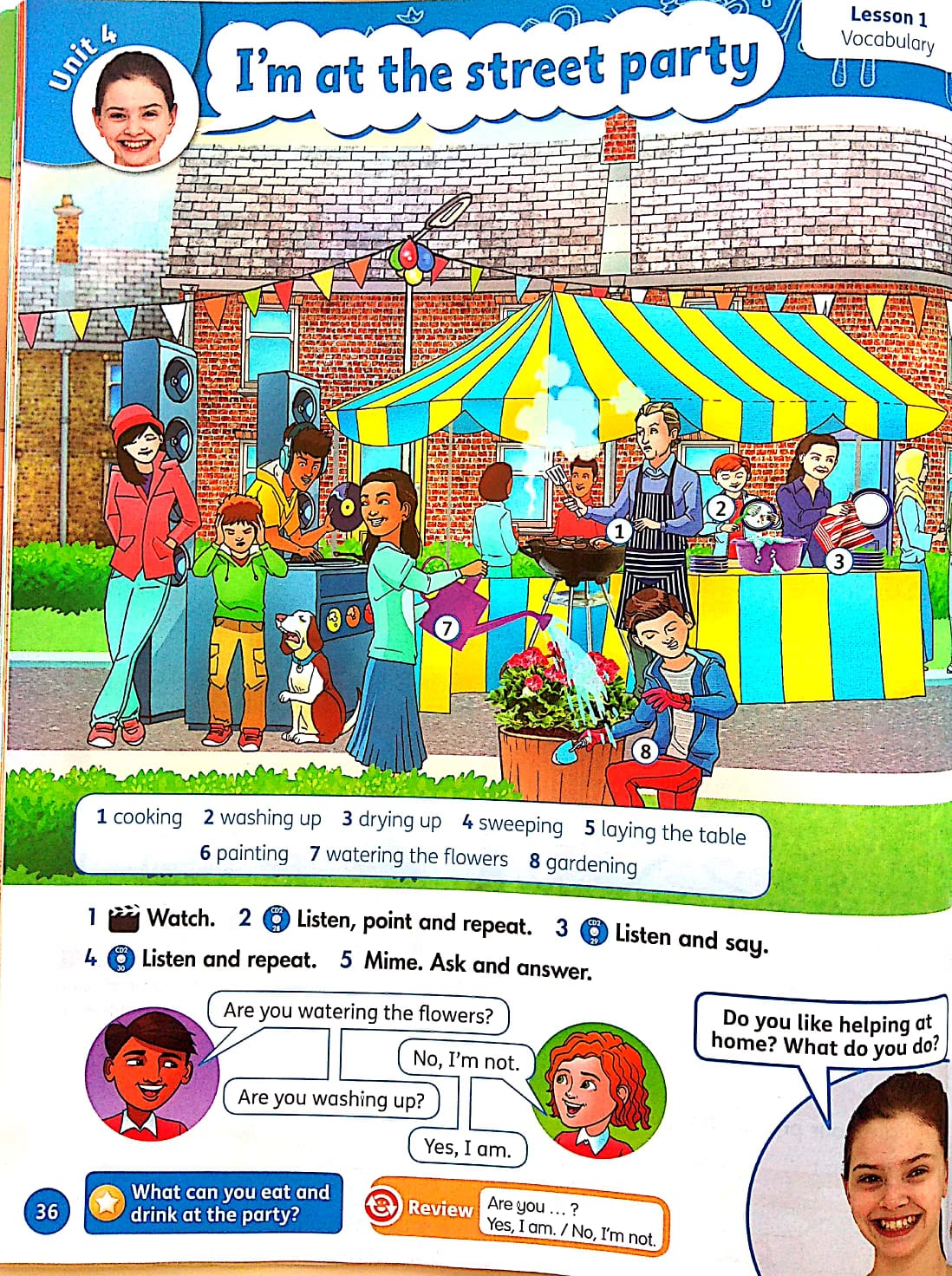
    Now describe what each member of your family is doing at home: cooking, washing up, drying up… (vocabulary Page 36 CLASS BOOK) (escaneada abajo). You have the vocabulary also in your notebook.  Example: My father is cooking pasta, my mother is reading a book, etc..
    For the writing, use the vocabulary Unit 4, CLASS BOOK: Page 36

    Ahora describe lo que está haciendo cada miembro de tu familia: cocinando, fregando los platos, secando... (vocabulario página 36 CLASS BOOK, escaneado abajo). También tienes el vocabulario en tu libreta. Ejemplo: Mi padre está cocinando pasta, mi madre está leyendo un libro, etc.


    SESIÓN 3

    • LIBRO PEQUEÑO AMARILLO “PROGRESS BOOKLET” (page 6)


    Ejercicio 1 - Vocabulary Unit 2.
    Look and Write the vocabulary. Mira y escribe el vocabulario.

    NOTA: Si no tienes el libro PROGRESS BOOKLET haz el ejercicio en tu libreta.

    - Brush your teeth
    - Go to school
    - Come home
    - Eat dinner
    - Get up
    - Eat breakfast
    - Watch TV
    - Go to bed

    Ejercicio 2
    Match the clocks above and write in your notebook the sentences. Une los relojes de arriba y escribe en tu libreta las frases.

    ACTIVIDAD VOLUNTARIA: Actividad de ampliación.
    Write on your notebook or on a piece of paper. Escribe en tu libreta o en un folio.
    - Write a short text describing the routines you have now at home. Escribe un texto corto describiendo las rutinas que tienes ahora en casa.


    • I get up at nine o'clock. I have breakfast at....

    Recuerda que hemos estudiado las horas:
    - En punto "o'clock". It's nine o'clock (son las 9 en punto) // I get up at nine o'clock. (me levanto a las 9.00)
    - Y media "Half past". It's half past nine (son las 9 y media) // I have breakfast at half past nine. (desayuno a las 9.30)